Only Good Handwritten: A Warm, Authentic Display Font for Makers
It started with a candle label. I’d just poured my first batch of lavender-vanilla soy candles and reached for the design file—ready to add that final, personal touch. But the font felt off: too stiff, too digital, too distant from the hand-poured, small-batch care behind each jar. Then I opened Only Good Handwritten. Instantly, it clicked—the gentle slope of the script, the subtle retro warmth in the letterforms, the way the lowercase “g” curls just so. This wasn’t just another handwritten font. It felt like a quiet nod to authenticity, like ink pressed gently onto kraft paper.
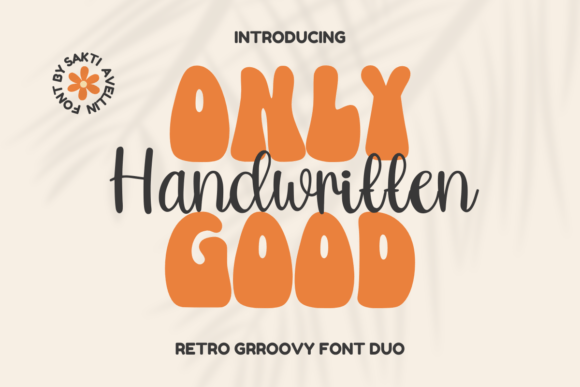
Only Good Handwritten is a thoughtfully crafted font duo: one expressive script paired with a companion retro display face. Together, they’re designed not for paragraphs—but for presence. The script carries soft rhythm and natural variation, evoking the charm of real pen-on-paper without looking overly ornate or fussy. The retro companion adds grounded contrast: slightly squared terminals, friendly weight, and a mid-century ease that pairs beautifully with handmade textures—linen, wood grain, uncoated cardstock, matte sticker vinyl.
I’ve used Only Good Handwritten across so many real product moments: printing boutique tags on recycled cotton tag stock, laying out wedding invitation suites for a friend’s farmhouse ceremony, designing printable planner pages with gentle headers and section dividers, and even mocking up seasonal mug designs for holiday shop updates. Its strength lies in how effortlessly it bridges tactile and digital—whether you’re cutting vinyl on a Cricut, exporting PNGs for Etsy listing previews, or sending files to a local print shop for letterpress greeting cards.
For physical products, readability matters—and Only Good Handwritten delivers where it counts. At 18–24 pt, the script reads cleanly on candle labels, gift tags, and packaging tape seals. On smaller stickers (think 1.5" round die-cuts), I lean into the retro companion font for names or short descriptors—it holds its shape beautifully, even at 14 pt. For wedding welcome boards or framed wall art prints, the script shines at larger sizes: 48–72 pt gives it room to breathe, letting those delicate entry strokes and intentional spacing sing.
What makes Only Good Handwritten especially valuable for makers is how well it supports brand consistency—not through rigidity, but through tone. When your shop voice is warm, intentional, and quietly confident, this font reinforces that without shouting. Customers don’t just see text; they feel the care behind it. That matters on a tote bag meant to be carried daily, on a thank-you card tucked inside a handmade soap box, or on a digital download preview that invites someone to imagine your design in their own space.
It’s not built for long blocks of body copy—and it shouldn’t be. As a display font, its role is to highlight, welcome, celebrate, and personalize. Think: “Hand-Poured in Portland” on a candle lid, “You’re Invited” on an envelope liner, “Good Things Grow Here” on a garden-themed printable, or “Est. 2023” on a boutique packaging seal. Short phrases, names, titles, and decorative accents are where Only Good Handwritten truly lives and breathes.
Pairing is intuitive. I often set the script headline over a clean, low-contrast sans serif—like Montserrat Light or Inter Regular—for ingredient lists, care instructions, or fine print on labels. For wedding stationery, I’ll layer the retro companion with a simple serif (think Cormorant Garamond or Playfair Display) for addresses and details—creating hierarchy without competing energy. And yes—I’ve even paired both Only Good Handwritten styles together: script for the couple’s names, retro for the date and location. It feels cohesive, not cluttered.
Before using Only Good Handwritten commercially—whether on physical goods, digital templates, SVG cut files, or printable bundles—I always double-check what’s included. The font files typically come in OTF and TTF formats, with OpenType features like ligatures and stylistic alternates that add nuance (a swash “y”, a connected “&”, a more relaxed “t”). Some versions include multilingual support—handy if you offer bilingual greeting cards or serve international customers. Most importantly, the commercial license covers resale of end products: printed labels, physical stationery, mugs, shirts, and digital downloads like Canva templates or PDF planners.
Real-world testing taught me a few small but meaningful things: on kraft paper labels, I bump the script’s tracking by +20 to prevent letters from visually crowding; for Cricut users, simplifying the script to basic characters (no swashes) helps with smoother cutting on intricate outlines; and for social media mockups, I export the retro companion as a flattened PNG at 300 dpi—it renders crisply even when scaled down for Instagram thumbnails.
Seasonal projects are where Only Good Handwritten really flexes its versatility. Last fall, I used the script for “Pumpkin Spice & Everything Nice” on a set of printable tea sleeve wraps—and the retro face for “Brewed with Love” underneath. For spring, it anchored a set of floral planner stickers: “New Beginnings” in script, “March • April • May” in retro. Even holiday tags—“To: Emma • From: Mom”—felt tender and timeless, not trendy or dated.
At its heart, Only Good Handwritten isn’t about perfection. It’s about presence. It’s the kind of premium font that reminds you why typography matters in handmade work—not as decoration, but as continuation of voice, values, and craft. Whether you're designing your first Etsy listing or refreshing your entire shop’s brand identity, it’s a creative font that doesn’t ask you to shout, but lets your sincerity show—clearly, warmly, and unmistakably yours.